Schwa Meaning, Sound, Word, Definition
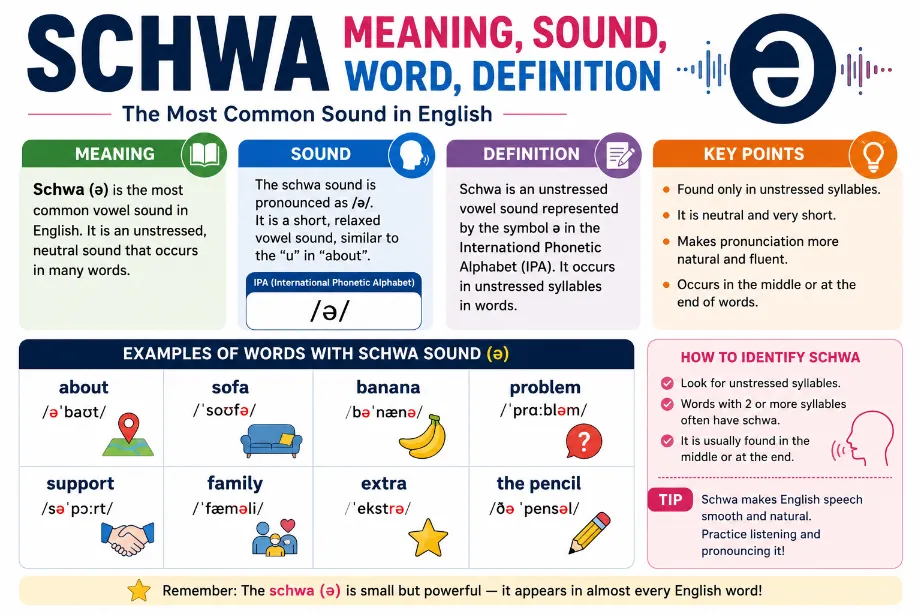
The schwa is the most common vowel sound in spoken English. It appears in unstressed syllables and has the IPA symbol /ə/. The sound is short, relaxed, and neutral, so it may resemble a very light “uh” sound.
For example:
- about → the first vowel uses schwa: /əˈbaʊt/
- sofa → the final vowel may use schwa: /ˈsoʊfə/
- banana → the middle vowel can use schwa: /bəˈnænə/
- support → the first vowel uses schwa: /səˈpɔːrt/
The spelling of a schwa can vary. Letters such as a, e, i, o, and u may represent /ə/ in an unstressed syllable.
Schwa Definition
A schwa is an unstressed, central vowel sound represented by /ə/ in the International Phonetic Alphabet (IPA).
It has these main features:
| Feature | Schwa |
|---|---|
| IPA symbol | /ə/ |
| Sound type | Vowel |
| Usual position | Unstressed syllables |
| Tongue position | Central |
| Mouth position | Relaxed |
| Sound quality | Short, neutral vowel |
| Stress | Unstressed |
The schwa does not have one fixed spelling in English. Its sound depends more on syllable stress than on the letter used to spell the syllable.
Schwa Sound
The schwa sound comes from a relaxed mouth and tongue position. The tongue stays near the center of the mouth, while the jaw remains fairly loose.
Try saying a relaxed “uh” sound without putting strong stress on it. That gives a useful starting point for /ə/.
A few points help produce the sound naturally:
- Keep the mouth relaxed.
- Avoid stretching the lips.
- Keep the tongue near the center of the mouth.
- Use very little vocal effort.
- Keep the syllable short.
- Avoid giving the vowel strong stress.
The schwa usually sounds weaker than the stressed vowels around it.
Schwa Pronunciation
The IPA symbol for schwa is /ə/.
schwa (shwä)
The sound itself does not match the strong vowel in words such as cat, bed, or food. Its quality stays neutral because the speaker reduces the vowel during an unstressed syllable.
Schwa in English
English uses schwa heavily in everyday speech. Native speakers reduce many unstressed vowels, which makes spoken English sound smoother and more natural.
Consider these examples:
| Word | Schwa location | IPA |
|---|---|---|
| about | first syllable | /əˈbaʊt/ |
| ago | first syllable | /əˈɡoʊ/ |
| banana | first and final syllables | /bəˈnænə/ |
| sofa | final syllable | /ˈsoʊfə/ |
| support | first syllable | /səˈpɔːrt/ |
| pencil | final syllable in some accents | /ˈpɛnsəl/ |
| doctor | final syllable in some accents | /ˈdɒktər/ |
Accent can affect the exact vowel used in a particular syllable. British and American English, for example, may differ in the treatment of final unstressed vowels.
Schwa and Stress
Schwa has a close relationship with stress.
A stressed syllable receives greater prominence through features such as pitch, length, loudness, and vowel clarity. An unstressed syllable usually receives less prominence, making vowel reduction possible.
For example:
PHOtograph
phoTOGraphy
The vowel pattern changes partly because stress shifts within the related forms. Reduced vowels can appear in unstressed positions.
This gives English its characteristic rhythm. Strong syllables carry more weight, while weaker syllables become shorter and less distinct.
Schwa Examples
Here are common English words containing the schwa sound:
- alone — /əˈloʊn/
- again — /əˈɡɛn/ or /əˈɡeɪn/
- around — /əˈraʊnd/
- away — /əˈweɪ/
- ago — /əˈɡoʊ/
- sofa — /ˈsoʊfə/
- banana — /bəˈnænə/
- family — vowel reduction may occur in the middle syllable
- animal — the final vowel can reduce in some accents
- problem — the final vowel may reduce in some varieties of English
The exact pronunciation can vary by accent and speaking style.
Schwa Sound in Different Letters
One reason learners find schwa tricky is its flexible spelling.
The same /ə/ sound can appear through different vowel letters:
| Letter | Example | Schwa position |
|---|---|---|
| A | about | first syllable |
| E | taken | final syllable in many accents |
| I | possible | unstressed vowel |
| O | police | first syllable in many pronunciations |
| U | support | first syllable |
This means spelling alone cannot always tell you the vowel sound. Syllable stress provides a stronger clue.
Schwa vs “Uh” Sound
Many learners describe schwa as an “uh” sound, and that description works as a rough pronunciation aid. Yet /ə/ has a specific phonetic role.
The main difference comes from stress.
A strong vowel can receive full stress and maintain a clear vowel quality. Schwa normally appears in a weak, unstressed position.
For example, the first vowel in about has a reduced quality, while the second syllable carries the main stress.
Schwa in Connected Speech
Natural English speech contains many reduced vowels. Words that sound clear and separate in careful speech may become shorter during ordinary conversation.
Function words such as a, an, the, to, for, and can also show vowel reduction in suitable speech patterns.
Examples:
- a book may use a reduced vowel in a
- to school may use a weak form of to
- for you may use a reduced vowel in for
This reduction helps English maintain its rhythm and allows speakers to move smoothly from one syllable to another.
Schwa in American English
American English uses schwa extensively in unstressed syllables. It can appear in the middle or at the end of words, depending on the word and accent.
For example:
- about → /əˈbaʊt/
- ago → /əˈɡoʊ/
- sofa → /ˈsoʊfə/
- support → /səˈpɔrt/
Some American English speakers use a different reduced vowel in certain final syllables, especially after consonants such as l or r. Regional speech patterns can change the exact sound.
Schwa in British English
British English also makes extensive use of schwa in unstressed syllables.
Examples such as about, support, sofa, and banana can contain /ə/. Some British accents also show clear differences in final unstressed vowels compared with American English.
The important point for learners remains the same: unstressed syllables frequently use reduced vowels.
Schwa and the IPA
The International Phonetic Alphabet uses /ə/ for the schwa.
The symbol belongs to the group of central vowels. Its usual articulation places the tongue near the middle area of the mouth rather than toward the front or back.
| IPA | Name | General description |
|---|---|---|
| /ə/ | Schwa | Mid central, unstressed vowel |
| /ɪ/ | Near-close front vowel | Common in words such as “sit” |
| /ʌ/ | Open-mid back/central vowel | Common in words such as “cup” in many accents |
| /ɛ/ | Open-mid front vowel | Common in words such as “bed” |
These symbols represent different vowel qualities, even though learners may sometimes hear them as similar during fast speech.
Why Schwa Matters in Pronunciation
Schwa helps explain why English pronunciation can differ from spelling. A vowel letter may have a reduced sound in an unstressed syllable, so reading every vowel with its strongest sound can make speech sound unnatural.
For pronunciation practice:
- Mark the stressed syllable first.
- Look for weak syllables around it.
- Check the IPA transcription.
- Listen for reduced vowels.
- Keep /ə/ short and relaxed.
- Practice the whole word rather than the isolated vowel alone.
Common Schwa Mistakes
Several habits can make schwa harder to produce naturally.
Giving every vowel full strength:
English does not give equal weight to every syllable. A reduced vowel can sound much lighter.
Reading directly from spelling:
A written vowel does not always keep its full vowel sound.
Holding the sound too long:
Schwa usually has a short duration in ordinary speech.
Adding too much mouth movement:
The sound needs a relaxed articulation rather than a strongly shaped vowel.
Putting stress on the wrong syllable:
A vowel may reduce precisely because its syllable lacks stress.
Schwa in Word Stress
Schwa and word stress work together in many English words. A stressed syllable usually keeps a clearer vowel, while an unstressed syllable may reduce.
For example:
- PHOtograph
- phoTOGraphy
- PHOtographic
The location of stress changes the vowel pattern across related forms.
Learners can improve pronunciation by marking stressed syllables before practicing reduced vowels.
Schwa Meaning in Simple English
In simple terms, schwa means the weak “uh”-like vowel sound found in many unstressed English syllables.
Its IPA symbol is /ə/.
Remember these points:
- Schwa is a vowel sound.
- Its IPA symbol is /ə/.
- It usually occurs in an unstressed syllable.
- Many different letters can represent it.
- The mouth and tongue stay relaxed.
- Accent and speaking style can affect its exact use.
- Schwa plays a major role in natural English rhythm.
Schwa Word Examples
A useful practice list:
| Word | Example pronunciation | Schwa |
|---|---|---|
| about | /əˈbaʊt/ | First syllable |
| around | /əˈraʊnd/ | First syllable |
| ago | /əˈɡoʊ/ | First syllable |
| support | /səˈpɔrt/ | First syllable |
| banana | /bəˈnænə/ | Reduced syllables |
| sofa | /ˈsoʊfə/ | Final syllable |
| teacher | /ˈtiːtʃər/ | Final syllable in rhotic accents |
| doctor | /ˈdɒktər/ | Final syllable in many accents |
Schwa Sound Practice
Start with short words and then move into phrases.
Stage 1: Single words
- about
- ago
- away
- support
- sofa
Stage 2: Short phrases
- about the house
- ago today
- support the team
- a sofa
- away from home
Stage 3: Natural speech
Say each phrase at a comfortable pace. Give full attention to the stressed syllable and keep the weak vowel relaxed.
Schwa Meaning, Sound, Word, Definition — Final Summary
The schwa /ə/ is a central, reduced vowel sound that appears mainly in unstressed syllables. English spelling can represent it with several different vowel letters, so pronunciation depends on syllable stress and the surrounding sounds.
For learners, the easiest rule is:
An unstressed English vowel may reduce to schwa.
That small sound has a large role in natural English pronunciation, rhythm, and connected speech.